
Why Smart CEOs Stop Winging It With HR

Subheadline: When your business is small, handling HR as you go might seem good enough. But as your company grows, reactive decisions become expensive. Here's why successful CEOs stop figuring it out as they go and start treating HR as a business strategy and not just an administrative task.
Most CEOs don't start a business because they're passionate about HR. They start businesses to build something meaningful, serve customers, and grow their company.
In the early days, it's common to handle people issues as they come up. You hire when you need someone, you write policies when a problem arises and you solve employee issues one conversation at a time. And for a while, that works.
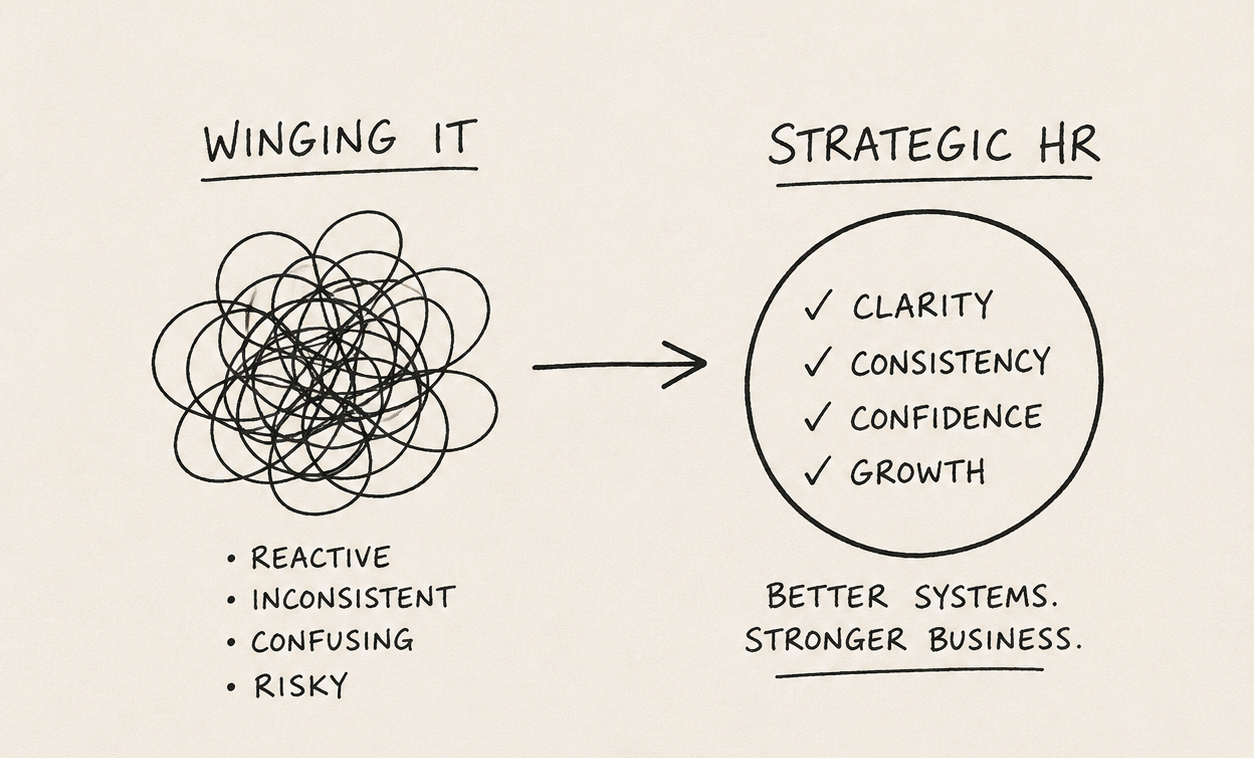
But as the organization grows, this work format should evolve too. The team gets bigger, managers take on more responsibility, regulations become more complex and decisions affect more people. At this stage, winging it isn't saving you time, it's creating confusion, inconsistency, and unnecessary risk in your organization.
The smartest CEOs recognize this early and build HR systems that support the business before they become necessary.
Key Takeaways
Reactive HR often leads to inconsistent decisions, wasted time, and avoidable risk.
Strategic HR gives leaders clarity, consistency, and confidence as the business grows.
CEOs don't need more HR paperwork, they need better systems that support smarter leadership.
Why "We'll Figure It Out Later" Eventually Stops Working
Every growing business has a stage where informal processes start breaking down. At first, everyone knows each other, questions are answered with a quick conversation, the roles are flexible, and decisions happen quickly. But then the company grows, new employees join, managers are promoted, teams become larger and hence the communication becomes more layered.
The systems that once felt simple now create uncertainty because they are unfit for a larger organization. You begin hearing questions like:
Who approves this?
How have we handled this before?
What's our policy?
Who's responsible for making this decision?
If there isn't a clear answer, the CEO usually becomes the answer and that’s not a sustainable solution in the long-term.
HR Shouldn't Only Show Up When There's a Problem
One of the biggest misconceptions about HR is that it's only needed when something goes wrong in the organization.
An employee resigns, a conflict needs to be resolved, a policy needs updating or a difficult conversation that can't wait any longer. But by that point, HR is already reacting! Strategic HR works differently; instead of jumping in at the last minute to fix an issue, it works consistently to avoid having issues in the first place. This shift saves time, money, and a tremendous amount of leadership energy.
The Cost of Winging It
Many CEOs don't realize how much reactive HR is costing them because the costs don't show up on a financial report. Instead, they show up as:
Inconsistent decisions
Hiring processes that change every time there's an opening
Unclear employee expectations
Performance issues that linger too long
Leaders spending more time solving people problems than growing the business
Individually, these issues seem manageable but together, they slow your organization’s growth.
What Strategic HR Looks Like
Strategic HR gives leaders the structure they need to make better decisions consistently.
Reactive HR | Strategic HR |
❗Hires when there's an emergency | ✅Plans hiring based on business goals |
❗Writes policies after problems happen | ✅Creates clear expectations before problems arise |
❗Solves the same issues repeatedly | ✅Builds systems that prevent recurring issues |
❗Depends heavily on the CEO | ✅Equips managers to lead confidently |
❗Focuses on today's problems | ✅Prepares the business for tomorrow's growth |
Build Systems Before You Need Them
One of the best decisions a CEO can make is building structure before growth demands it.
That includes things like:
Clear job descriptions
Consistent hiring processes
Structured onboarding
Leadership development
Performance expectations
Employee documentation
Succession planning
These create confidence that the business can keep growing without depending on one person for every answer.
The Best CEOs Think Ahead
The strongest leaders recognize patterns early and invest in better processes before those issues become larger obstacles. It's because they understand that every people decision affects the business. Strategic HR creates an organization that can grow without unnecessary friction.
A Note from Serena
One thing I've learned from working with CEOs over the years is that most of them don't need more complexity, they need more clarity. When HR feels overwhelming, it's usually because everything depends on one person.
The businesses that grow confidently have clear systems, prepared leaders, and practical processes that support the business every day.
At Executive Compass, I help CEOs simplify the people side of their business so they can spend less time reacting and more time leading. Because good HR should make your job easier.
Want to accelerate your organization's growth?
Call 760-504-6352
Email to serena@execucompass.com
Frequently Asked Questions
When should a growing business stop handling HR informally?
As soon as people decisions start becoming inconsistent or taking up too much leadership time. If you're regularly solving the same employee or management issues, it's time to build stronger HR systems.
Is strategic HR only for large companies?
No, in fact, small and growing businesses often benefit the most because good HR systems create a strong foundation before rapid growth introduces more complexity.
What's the biggest difference between reactive and strategic HR?
Reactive HR solves today's problems. Strategic HR builds processes that prevent tomorrow's problems while supporting long-term business goals.


Comments